Sunday, 27 August 2023

Open Out


It's here!

After a little bit of a delay, my new book Pull to Open has finally been released! Copies have been arriving with people over the past week, and very excitingly on Friday I received a box with my copies inside. Not that I'm so massively egotistical as to want lots of copies of my own book hanging around the place - although I do want some, of course! - but there were various people to whom I'd promised copies.


I am very proud of it - and the pleasing thing is, it seems to be going down very well so far with those who have read or are in the process of reading it. Earlier this month I recorded the first interview I'd done with someone about the book with someone who'd actually read it, which obviously was a nervous moment. But Steven Schapansky of the Radio Free Skaro podcast was extremely complimentary, and was kind enough to record a very long chat with me for their most recent edition which was released last Sunday. If you'd like to have a listen to that, you can do so here:


There's also been a very kind review from the Sci-Fi Bulletin website - 9 out of 10, I'll take that! And it was also flattering to see Doctor Who Magazine generate a nice amount of space to the book in their 'Gallifrey Guardian' news pages. This was the medium through which I first read about so much Doctor Who news and heard about so many new books and products when I was a child and a teenager, so it was very pleasing to see it featured there. I've also done interviews about the book for the CultBox website, and for the Who's Views YouTube channel.


As the book has been arriving with people in recent days, one of the things that's been nice has been seeing photos posted on social media as it's excitedly shared that they have it. Many of them also sharing the free Sydney Newman sticker, in the style of the 1972 Sugar Smacks stickers, which they get with it! Thanks to Paul Burley for creating that one. People being excited to receive a book that I have written is one hell of an ego boost, as I might imagine. I just hope these people are all as pleased by it once they've read it!


There've also been some very generous comments online, including very flatteringly from the esteemed Doctor Who historian, and general television historian, Andrew Pixley. One aspect I'm particularly pleased about is that people seem to be enjoying one of the main elements of the book, providing extra background and context about British television and the BBC of the time, to try and give more of an idea of the world into which Doctor Who emerged and why certain things happened. I knew that people like me would probably enjoy it - so it's nice to know that there are other people with tastes along those lines out there to justify that faith!

But anyway, yes - an extremely successful launch so far, I'd say. I really am very happy and very proud.

I should also add that before the book came out I was kindly interviewed by The Doctor Who Show podcast - another very enjoyable interview which if you wish to hear you can find below. The start of another 'Podcast Book Tour', perhaps? If any other podcast producers out there would like a chat, I'm more than happy to oblige!

Friday, 7 July 2023

Another Passion

 
Anybody who's cast even the most casual of glances across the content of this blog would be left in no doubt that I am a Doctor Who fan. It's the enthusiasm of mine which gets written about the most here, which is no surprise because this is a blog about my writing and it so happens that Doctor Who is the subject about which I have found myself most often professionally engaged to write.

(On the subject of which, by the way, thanks to The Doctor Who Show podcast for once again interviewing me, as they did for The Long Game, about my new book. You can hear the interview here if you'd like to know more about the book).

But there other things in life in which I am interested, of course. Not least among them is Formula One Grand Prix motor racing, of which I have been a dedicated armchair follower since I was 11 years old and happened across the 1995 Brazilian Grand Prix on television one Sunday afternoon. 

It's not that Formula One has never crossed my path professionally at all. Back in 2014 I was fortunate enough to make a documentary about Ayrton Senna's early career in Norfolk which gained some success, and last year I produced a documentary telling the story of George Russell's first year with the Mercedes team. 

More recently, however, I have been helping to look after our weekly Racing Torque motorsport show at work, and at the end of last month this resulted in an incredible opportunity to visit the Oxfordshire headquarters of the Williams Formula One team - one of the great names of the sport, and the team of which I became a fan when first starting to follow F1 in 1995.

This of course resulted in a report for Racing Torque, various other bits and pieces across the station - and, for the first and probably only time, a bylined piece by me on the BBC Sport website. Yes, for this week only, I have been able to have a little bit of a play at being an F1 journalist!


Which is of course immensely pleasing, and another reminder of how very lucky I have been to have this job, and the amazing things I have been able to do through it.

Something else I have done this week which was equally, if not more, pleasing was a piece for BBC Radio Sussex, about my old primary school's 150th anniversary celebrations which I went to last Sunday. After 16 years in the BBC, it was nice to be able to finally do a piece for my "home" station - and in my home village, too, celebrating that school. And if I had been able to go back in time and tell the 11-year-old me who left that school in the summer of 1995 that in 28 years' time he would be writing professionally-published books about Doctor Who and getting to visit the Williams headquarters, on BBC duty for his actual job... Well, I can't help but think he would have felt things hadn't turned out too badly.

Mind you, he would probably have a go at me for not having had a novel published yet... But there's still time!

Wednesday, 21 June 2023

Pull to Open


Yesterday evening was very exciting for me. After a long time waiting for everything to be sorted and settled and ready and it to be appropriate for it to be made public, my publishers (and it feels exciting itself just to be able to say that!) Ten Acre officially announced my new book! It’s called Pull to Open, it tells the story of the creation of Doctor Who in 1963, and it will be released on the 24th of July.

I wrote the book through 2022, and Stuart at Ten Acre was gratifyingly very keen to take it when I sent it to him at the end of the year. It’s taken a while having to wait for certain bits and pieces to fall into place and doing some edits and other admin, but finally we’re almost there and the time was right to announce.
 
But why, some people may ask, go back to 1963 again? Why go back to tell a story which has been told before? When even in the introduction to The Long Game I mentioned how although the creation of Doctor Who was a story which had long fascinated me, it was one which had already been well-told by others.
 
So why have my go at telling it now?
 
Well, I gradually came to realise that although that was true, it had never been told in quite the way I fancied telling it.
 
Doctor Who: The Sixties, a Christmas present I received in 1993 which helped start me off on this journey.
After The Long Game had come out in the autumn of 2021, it became clear that I could, in fact, write something other people would want to read, and I had done a pretty good job of it. Lots of people bought it. Lots of people said very nice things about it. At the very end of the year, in one of the interviews I did to promote the book, with AJ Black for his website, he asked me if I had any other books lined up.
 
“I can’t imagine ever writing another non-fiction book, either Doctor Who or otherwise,” I told him. “But you never know! If I am struck by a good idea for one I might give it a go. Certainly in Doctor Who terms, I think pretty much anything else I might want to write about has already been very well researched and written about by other people. Whereas with The Long Game I knew I had something new and a bit different which hadn’t formed the basis of a book before. If I ever think of something else like that, I might have another try!”
 
And that kept nagging at me, once the interview came out. It felt like a waste, somehow. All that good will I had built up with The Long Game, there had to be some way I could channel it into something else. Frankly, I knew that if I put my efforts in 2022 into t
rying to write fiction there was very little chance of it being published. If I put them into writing a non-fiction work, specifically a television history of particularly Doctor Who one, I knew that it would be at least seriously considered and probably had a very good chance of being published.
 
But what could it be…?
 

I’ve written before on this blog about how the creation of Doctor Who in 1963 has cast a kind of spell over me. I think many of us have particular little slivers of history, little eras, which form a kind of bubble of interest. Where a particular combination of the people and the circumstances and the background and the culture and the society all get a hook into our consciousness somehow.
 
BBC Television in 1963 is very much that for me. It’s why, nearly 20 years ago now, I had a go at writing the story of the creation of Doctor Who as a novel. That was no good, of course, and it would be no good trying that again. So what else could I do with that interest?
 
I did have one ‘way in’, as it were. In 2021, I’d written a piece for Doctor Who Magazine about the co-creator of the programme, Donald Wilson. This was something I’d first researched way back in 2015, and it was originally a much longer article, but eventually by the time it reached print there was only space for a shorter piece. But I still had all of that writing and research. I knew I had a ready-made chapter on Wilson’s life.
 
But a chapter of what…?
 
Once again, it came back to that nagging feeling. Another book. A Doctor Who book. And finally, the realisation that I could tackle the very start of the show in a way which I didn’t think had been done before.
 
Firstly, with this book, the creation would be the story. Those books I’d loved so much in my childhood and my teens, like Doctor Who: The Sixties or The Handbook: The First Doctor, had begun the story and then carried on to tell the tale of a whole era. This book would only go up to the end of 1963 – the point at which Doctor Who was about to go nuclear, so to speak, as the Daleks rolled onto Britain’s screens for the first time. Poised with a happy ending, just as The Long Game was with its finale of the return of the show being announced in September 2003. A perfect, ready-made narrative structure.
 

But secondly, I knew from the kind comments I’d had that one of the things people had really enjoyed about The Long Game was the way in which it provided the wider background and context of what was going on in the BBC at the time. Who these people were who had taken these decisions, and how they’d come to be in those jobs at that time. Not just what had happened and when, but why it had happened. How the BBC and the wider British television industry was working at that point in history.
  
I knew that if I could bring all of that, and combine it with the strong narrative thread of the events slowly coalescing for Doctor Who to rise into existence, I could write a really strong book. With 2023 being the show’s 60th anniversary year, it seemed perfect. So, hopefully, that’s what I’ve done. On the 16th of January 2022, I sat down at my laptop and typed the opening words: “When did Doctor Who begin?” There’s been a lot of writing, research and effort since then, but now, 130,000 words later, I have a book.

Among all the many, many lovely comments I’ve had since Pull to Open was announced by Ten Acre yesterday evening, one of the ones by which I was most touched was from a user called DeeDeeTee on the GallifreyBase Doctor Who forum. They wrote that: “The Long Game was an incredible read. Paul's skill is managing to tell the history of the BBC through the history of the show. I'm really looking forward to seeing how he weaves this magic in telling the story about the very beginning...”

It’s a wonderful feeling to find that someone you don’t know at all has read something you have written and understood exactly what you were trying to do with it. Trying to explore and explain part of the deep, rich and complex history of the BBC through the narrative of how that history influenced the development of Doctor Who.

Whether or not I have succeeded… Well, time will tell. We’ll see what people make of it next month.

Monday, 27 March 2023

Running the Show

Doctor Who Magazine released a new special edition earlier this month, focusing on the producers / showrunners from across the history of the programme from 1963 to the present day. I'm pleased to say that earlier this year I was asked to contribute a couple of pieces to this, and they've now appeared in the finished version as my first professional writing efforts of 2023.

I was asked to write the pieces focusing on Doctor Who's one-off 1990s return in the form of the 1996 TV Movie and its producer Philip Segal. I was glad to be able to do this as the TV Movie is a production for which I have an enormous amount of affection. Even though it ended up of course with the disappointment of not leading to any new series, as a 12-year-old I found it incredibly exciting - to actually have new Doctor Who! The show had been off-air as a going concern since I was five years old, a lifetime at that age, and even though the Doctor Who videos I bought with my paper round money were mostly all new to me, I knew that I wasn't quite the same. This was different. This was properly new. Doctor Who was back!

As I say, it sadly wasn't to last, and we had to wait nearly ten years for the proper return. But the fact that it did eventually come back makes it all the more possible to look affectionately on the TV Movie, so I was pleased to be able to write about Segal and also to interview the movie's writer, Matthew Jacobs, who very kindly spared me some time to chat via Zoom from LA.


That's not the only exciting thing about this latest DWM special for me, though. In one of the pieces after mine, Eddie Robson writes about Russell T Davies... and refers to The Long Game, as if it's a proper book by a proper writer! I found this enormously flattering and, of course, quite the ego boost!

I'm also rather pleased to have contributed to DWM again for the first time under the new version of the old 'diamond' logo, which it recently adopted. This pleased me purely for nostalgic reasons - the magazine was using the older version of that logo when I first became a reader of it in the mid 1990s.

The Doctor Who Magazine 'Showrunner' special is out now from Panini, available at WH Smith's or online.

Saturday, 31 December 2022

Old Year's Night

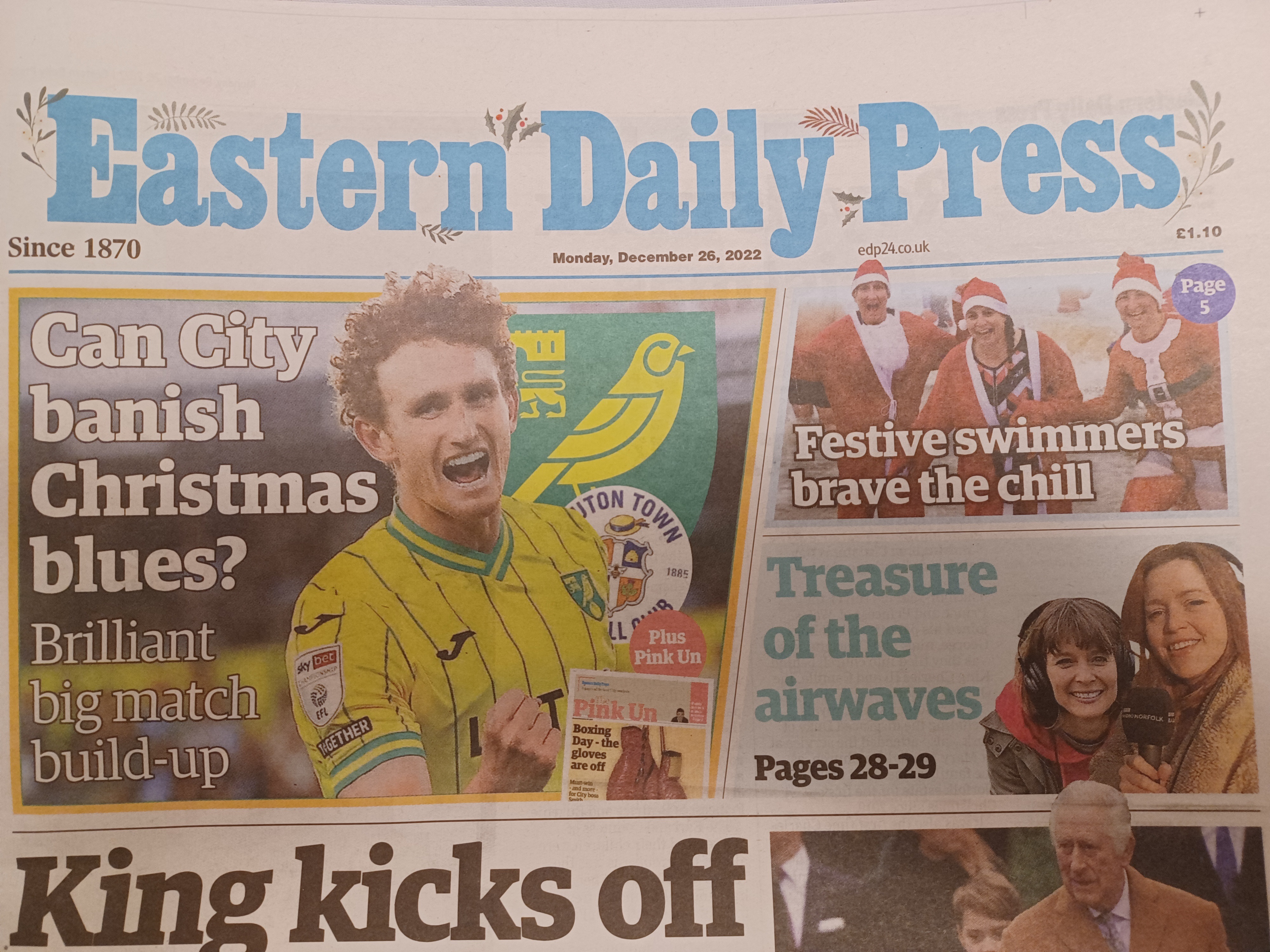
A front page mention for my Boxing Day piece in the EDP

It's that time of year again - time to look back over what I have achieved over the past twelve months, and to wonder what the next year might have in store.

I fear I must report that, as with last year, not only am I no closer to achieving my dream of having a novel professionally published, I basically made no effort at all to achieve anything in that direction throughout 2022. I barely wrote any fiction at all - just a few fragments here and there for projects which will almost certainly never see the light of day.

However, I do have some excuse. Back in January, I set myself some targets for the year. Having decided after the success of The Long Game that, for the time being at least, it was far more worthwhile to put my efforts into non-fiction than fiction, I decided to have a go at writing another factual book. This I now have a draft of, it seems to have gone reasonably well, and fingers crossed it looks as if it may appear sometime in 2023 - more on that as and when.

So one target was to write a draft of a new non-fiction book, and I have achieved that. The other was related to my day job - I wanted to make two more radio documentaries. I had in mind from very early on what I wanted them to be, too. One about Banksy's "Spraycation" in the summer of 2021, to go out around the first anniversary of it happening and using bits of our live programming from the time to tell the story of what happened. The other was a local documentary for the BBC's centenary celebrations, and I managed to achieve both of these. In fact, I ended up not only making these two, but four documentaries altogether this year - also doing one the week the Queen died with some local remembrances and archive, and one for this Christmas looking back at local Formula One driver George Russell's first year with the Mercedes team. We even got to speak to George for this, which as a big armchair Formula One fan I enjoyed putting together.


I think, then, that I can look back on the year with some satisfaction. I was also able to carry on writing some other bits and bobs. I was flattered to be asked to make some more contributions to Doctor Who Magazine, and the Eastern Daily Press printed some more features of mine tied-in with some of our radio programmes. I even managed to squeeze another one of the latter in before the end of the year, with a Boxing Day piece about our Treasure Quest special.

This time last year I wrote that there was some exciting news coming up radio-wise, which was that in January my 2021 Nexus documentary got a national airing on 4 Extra, which was immensely pleasing - especially it getting good write-ups in The Times and the Radio Times.

So all of that was good, and once again I look back on a year when I have been very fortunate and can be satisfied that I was able to use whatever writing skills I have in a professional capacity. And yet...

I still have to face up to the fact that I am basically middle-aged now, and still after all these years of ambition I have never been able to earn any money at all from writing any fiction. You'd think I'd be able to get a little something in somewhere, but no. 

I just have to try harder, I suppose. I'm not sure what avenue I could pursue to try and achieve that during 2023, but getting back to fiction more generally will have to be on the list. After all, you can't become a novelist if you're not at least trying to write novels...

Happy New Year, everybody!

Monday, 14 November 2022

The BBC and Me

Today marks the 100th anniversary of the BBC first going on the air. Exactly a century since Arthur Burrows read that same opening news bulletin twice in a row, once normally and then more slowly, so that listeners could write in and say which they preferred.

I had a BBC 100 programme on yesterday, but this is a more personal piece

Like everybody who has grown up in the United Kingdom in the hundred years since then, I cannot tell you when I first became ‘aware’ of the BBC. It has simply always been there – a part of the fabric of life in this country. Love it, hate it, be indifferent or ignore it, you always know it’s there.

I did love it, and from a very early age. As a young child I was an avid viewer of the Broom Cupboard days of Children’s BBC in the late 1980s and early 90s, and can remember having the absolute conviction that the BBC were the ‘good guys’ and ITV were ‘the enemy’. Where this came from, I don’t know. I’ve heard people talk down the years about households where children weren’t allowed to watch ITV because their parents for some reason or other disapproved of it. Whether that ever actually happened or not I don’t know, but our family certainly wasn’t like that. My mum was in many respects the model ITV viewer. But for whatever reason, I got it into my head as a child that I was on the BBC’s ‘side’.

Of course, Doctor Who may have had a lot to do with it. The BBC made Doctor Who, and so they had to be the ones on the side of the angels, right? That was certainly a reason why I became fascinated about how the BBC worked, and its history. Doctor Who is one of the most closely-studied and heavily written-about programmes ever shown on British television, and it was through reading books about the series and its history when I was growing up that I developed a deep interest in the BBC and the history of broadcasting in this country more generally.

I don’t think, though, that it ever entered into my head that I might one day be able to work for the BBC. It just wasn’t something that I ever thought about. I don’t know if I had a notion of what ‘type’ of person worked for the BBC, as such, but it never occurred to me as something I could try to get into. It seemed such a far-off distant thing, plus of course much of what I read about and found interesting about the BBC was in the past. The notion that the BBC might be a part of my future was too incredible to contemplate.

It was only after leaving university and being confronted with the reality that I now had to work out what to do with my myself that the BBC became a part of my life. While doing a very morale-sapping, boring day job four days a week I started volunteering at the BBC in Norwich on the other day in the summer of 2006. This meant that I was given an ID pass to get into the building – and when I was given it, I could not stop looking at it. Holding it in my hands and staring at it. I took photos of it, in case this didn’t last very long and they wanted it back, so that I could have some memento, some proof I’d once had it. That I had been a part of the BBC.

The BBC! Me!

I have proudly worn that pass into the building every time I have gone in there for the past 16 years. It’s a bit battered and marked now, and the photo resembles me less and less every year. But if I hold it in my hands and look at it, that logo there with my name, I still feel that same pride and disbelief. That I could have become a tiny part of this great organisation which I have loved since I was a child. That I work for the same BBC as all those people I have watched, listened to, looked up to and admired.

I had that same feeling of amazed excitement when I started getting paid shifts the following year, and then in early 2008 an incredible offer. There was a job they needed filling, full-time, for three months as someone had left and they weren’t sure what was going to happen to that particular role. They couldn’t guarantee it would last any longer than that, but would I come and do it…?

It did not seem a risk to me. Of course I said yes. The chance to say that I worked, even for just a few months, full-time for the BBC was irresistible. I was really, properly there. Even if this turned out to be the only exciting thing that ever happened in the rest of my life, it would be something to treasure and hold on to. That I worked for the BBC.

That three months has not, yet, come to an end.

The Eastern Daily Press kindly published a BBC 100 piece by me on Saturday, although sadly under the byline "Paul Haynes"!

For nearly 15 years now I have been in the incredibly privileged position, which I appreciate and value as being very rare in life, of not having to wake up in the morning and think, “Oh Christ, I’ve got to go to work today.” To be spared that crushing, soul-destroying heaviness of having to go and do a morale-sapping job I hate. Like any job, of course, life at the BBC has its occasional frustrations and annoyances. But never anything that lasts. Never anything that has ever made me not want to go back in.

I do understand how incredibly fortunate I am in that, and what a rare privilege it is – especially when it’s on the public payroll. There is always that dichotomy in the BBC, or perhaps any form of broadcasting, between doing something that you enjoy and doing something for the benefit of the audience – but especially so in the BBC when the audience are the ones directly paying for it. However, I like to think that I have always managed to resist ever becoming too self-indulgent, and that my instincts are not too far out of whack with what the listeners wanted in the role that I was in.

You can never please all of the people all of the time, of course, but I have been lucky enough to have been involved with some amazing programmes during my time with the BBC. I have written before on here about how special it has been to be involved with Treasure Quest, the Sunday morning show I have produced since just after I started working full-time at the BBC in Norwich. It’s an amazing thing to have been a part of – an out-and-out entertainment show, yes, but a very BBC one.

It may be primarily about having fun and playing the game, but every week through that format we publicise local events, charities and good causes. We’ve raised tens of thousands of pounds for Children in Need down the years, brought people together and cheered up their Sunday mornings. But also, of course – wow! I’ve been able to put together a programme which has messed about with putting presenters on trains, buses, and helicopters! Put them on-stage singing and dancing, through assault courses, up tall towers, and set them up being pulled over by the police or locked in guard cells by the army. We’ve put out books, CDs and calendars, and mounted our own stage shows; and we have a fanbase, a small but fervent one. It’s a producer-proof show, really – such a good idea that it only needed someone half-competent to steer it, and of course the reason the audience love it is because of the presenters. But I like to think I have put a lot into it and wrung everything out of it that I could have done, and put those presenters into situations which gave them the opportunity to really engage the audience in the way that they have.

So if I’d done nothing else in the BBC I could be incredibly proud of Treasure Quest. But it’s been so much more – all the features, items and documentaries I’ve had the opportunity to make. The hundreds, thousands of live programmes I’ve had the chance to produce. The difference we’ve been able to make to real lives in real ways, whether working into the night as the flood waters rose or helping someone work out how they were going to get food when they couldn’t leave the house in the early days of lockdown.

None of this is done alone, and although I am at heart a highly individualistic – even self-centred – person, some of the very finest moments at the BBC are when we come together to work as a team. On those flood nights or election nights or those big, set-piece Treasure Quest shows. During lockdown. Or even when it’s just the two of you, you and a presenter, getting the breaking items on the air or seeing the calls roll in because you’ve entertained and engaged people.

I’ve had the chance to present shows to a large chunk of England and to make programmes at the home of the BBC itself, Broadcasting House in London. I’ve produced podcasts downloaded by thousands of people all over the world and helped write articles which have been read by over a million. I have had the opportunity to do all of these incredible things because I am a part of the BBC, and the presence of those three little letters is what makes it magic. I am sure I could probably have had fun and enjoyed myself and done creative things if I had worked in commercial radio. But it would not have been the same. I am not saying this is some universal truth, or that everyone ought to feel this way – this is specific to me. It’s being part of the BBC which makes it special. Which gives a pride I don’t think I’d feel if I were working for any other organisation.

I was even once, just for five minutes in August 2021, responsible for the output of that very same station which Arthur Burrows opened back in 1922. Which had gone from being 2LO to the London station of the Regional Programme to the Home Service and eventually BBC Radio 4. I became a part of that when I made a piece for the Today programme. I was a link in that national chain which stretches back for a century.

I do not know whether the BBC will be around for another century. I do not even know what the future might hold for it in the rest of this decade. What form it should take and how it ought to be funded are not arguments which I can or should be a part of. If it were up to me, of course, I would like everything to stay the same, simply because that’s the nature of my personality. But I am grown-up enough these days to recognise that that’s neither possible nor desirable, in any area of life. Everything changes, and has to change.

The future of the BBC will be decided by those whom it serves. There has for a long time been a broad consensus in favour of it, and if we are still wanted and needed then hopefully that consensus can continue. But whether it can or it should is for others to decide.

If it all came to an end tomorrow, I would be devastated. I know that I would never again be lucky enough in life to find myself not just in a job that I enjoyed, but in a job that I was proud to do. The special part of my life would be over. But everything has its time, and everything ends, and the best parts of all our lives are finite.

I would still, though, have that feeling I had when I was asked to come and work for the BBC full-time back in 2008, when it might have been just for a few months. That it was worth it – so worth it. When the time comes, I will be able to look back and say that “I worked for the BBC.” That I achieved something in life, that I had a job which really meant something – to me, at any rate, which is all we can ask of in our work.

“The BBC,” someone once said, “will never love you back.” But I have never needed it to. I have given a lot to the BBC, but I have always felt that I have got so much more back than I have given. Both as a viewer and listener long before I ever worked there, and in the friendships that I have made there, the things I have done and the opportunity I have had to be creative every single day – and to be part of something greater than anything else someone like me could ever have been involved with otherwise.

Happy birthday, BBC. Thank you for everything.

Tuesday, 18 October 2022

Tales of the Century

Today marks the start of the centenary celebrations of the BBC - an organisation for which I am very proud to be able to say that I have the privilege and the good fortune to work.

It's exactly 100 years since the BBC was founded, although the proper on-air anniversary of the first BBC broadcast is not until next month - November 14th, to be precise. I'm working on a programme in my day job marking the centenary in our own little corner of the country, but today is a good excuse to be able to say that I've also been able to play a very small part in another aspect of the centenary celebrations.

The BBC have produced a special episode of Doctor Who for the anniversary, which is being broadcast this coming Sunday, the 23rd. To tie-in with this, the latest edition of Doctor Who Magazine comes with a special supplementary magazine called Doctor Who: A  BBC Production, telling the story of the BBC's history during Doctor Who's time in production and the background and context of the influence of the wider changes at the Corporation on how the series was made.

I was very fortunate to be asked to write a piece for this, looking at the BBC in 2000s. The magazine is available now from WH Smith's, supermarkets, and of course online from the publishers Panini.