I’ve got a piece in the latest issue of Doctor Who magazine,
which came out last week – a write-up of an interview which I actually
conducted six years ago. I’m glad I’ve finally been able to bring more of it to
print than has been the case before, and I wanted to write a bit here about the
interview and, particularly, its subject. I’m not sure when I would have first heard of Alan Yentob. I was interested from a young age in the behind-the-scenes
goings-on of the television industry, particularly at the BBC. And of course,
especially so when it was anything related to Doctor Who. So I suspect
it may well have been his teasing little cameo at the end of the Doctor Who
anniversary documentary 30 Years in the TARDIS on BBC1 in November 1993,
when I was nine years old, although I can’t say for sure. But certainly from that point he was someone I was aware
of and, in that strange way that you can form a view of someone that you don’t
know at all, he was someone who I ‘liked’. Especially as I grew older and moved
from my childhood and into my teens, where that interest in television history
started to combine with views – let’s face it, usually naïve and pretentious ones – about
how it was made in the present. Yentob, from what I could tell from a distance, seemed
like one of the ‘good guys’; a kind of tie to an old-fashioned version of the
BBC despite being dressed in a smart nineties suit. Someone who had the sense
of being a creative person, a programme-maker at heart, in a rather
bleak-seeming modern broadcasting world of business units and management
consultants. I remember being disappointed when he didn’t get the Director-General job in 1999. But Yentob did, of course, remain an important figure at
the BBC; both under Dyke and for several years beyond. His career as a staff member at the BBC had an incredible
span, from the late 1960s into the 2010s, and he was still going into the 2020s as a freelance presenter rather than an executive. Half a century and more, a BBC man all the
way through, from trainee up to the most senior ranks, as the Corporation
changed almost entirely all around him. When I was working on my book which eventually became The Long Game, I knew that he was someone who had been involved in both ends of
the story I was telling – the journey of Doctor Who from the aftermath
of the 1996 TV Movie to its recommission as a BBC series in 2003. So I also knew
that he was someone to whom I wanted to speak, to get both his specific
insights on those two events and his more general recollections of the BBC at
the turn of the century; the latter of which subject forms the key background
and context of the book. But how to contact him, when I was an absolute nobody and
a nothing who didn’t know anybody who might know him? I tried a standard-format BBC email address construction,
of course. Even though he was no longer staff by this stage – I was approaching
most of my interviewees in spring of 2020 – because he still presented Imagine…
I thought he might have a BBC address still, and the email did go through –
although possibly it disappeared into the ether. I looked at the credits on the
most recent Imagine… episodes, picked a likely candidate, guessed
another BBC email address formation and asked one of the producers if she might
pass on the request for me – which, slightly surprisingly, she agreed to do.
It felt unlikely any of this would get me anywhere. But then, suddenly, on May 12 2020, a month after I had first
tried contacting him… this: Hello Paul Apologies for what inow discover has been a marathon attempt to get in touch . Although this
email address is still intact , I rarely access it because it is overwhelmed
with unsolicited commercial material . Re Doctor Who ... I am happy to have a phone conversation but as you
know Jane Tranter andRussell Davies are
the principle movers and shakers in its revival . Despite the Lockdown , i am very busy over the next
ten days but should be free to speak soon after . i can’t promise that i can answer all your questions ,
but why don’t you send me a rough outline of what you would like to cover. As i
have now tracked your emails you can continue to use this address and i will
make sure to look out for them . Best wishes Alan Blimey. Actual, real-life, Alan Yentob was prepared to
speak to me, someone with at the time next to no track record other than a
handful of articles for Doctor Who Magazine. We arranged for a phone interview at the end of the month.
This being May 2020, it was deep into lockdown at the time, but I was still going into work rather than
having to do everything from home. I arranged to take my lunch break at the
time he said he’d call, and commandeered the meeting room, which was obviously
not often being used at that point, and sat there nervously at the big board room-style
table; phone resting ready to put on loudspeaker, and
digital recorder running to capture the conversation. (Yes, I work at a radio station, and yes, I could have
arranged to do it properly through one of the studios, but it wouldn’t have
been right – this wasn’t a work project, this was an entirely outside thing, so
it was important to do it on my own time with my own resources). We ended up chatting for half an hour, about Doctor Who,
the fraught state of the late 1990s BBC drama department, the granular details
of early 2000s commissioning processes, and the intricacies of relationships between production,
broadcasting, BBC Films and BBC Worldwide. I thought it was interesting that he
was aware – although he had said this before, I think in the Seven-Year
Hitch documentary about the TV Movie – that he had been regarded by Doctor
Who fans in the nineties as someone who was on the side of the angels as
far as the show was concerned. But the bit of the interview which most sticks in my mind
is when he asked me how many episodes of Doctor Who there had been,
first time around. I was taken a bit off-guard by this and suddenly doubted
myself about the precise figure, so I approximated it to over six hundred –
which prompted a pause, and then a slightly incredulous: “Are you serious!?”
I also remember it wasn’t the easiest of interviews. Not
because he wasn’t forthcoming or polite, but because he had clearly spoken
about Doctor Who so often before that he had certain mentally-prepared
answers, and initially was replying with these composed thoughts rather than
answering the actual questions I’d asked. It was one of those interviews where
it’s a bit like the old turning-an-oil-tanker metaphor; you had to gradually
bring the conversation around to what you actually wanted to discuss.
But certainly when we got to those specific areas he wasn’t evasive about any of it. I was incredibly fortunate with The Long Game that
despite these people knowing nothing about me at all, and that I could have
been a mad fan with a crayon for all they knew, I was able to speak to almost
everyone I wanted to for the book. Everyone I got was a punch-the-air moment,
but Yentob was definitely one of the special ones. But it was only when his death was announced a year ago, in May 2025 five years on from our
interview, that I realised just how
important to that book Alan Yentob actually was. And is. He’s someone most of
those with an interest in the subject will have heard of, and have some
awareness of what a major figure he was in the BBC at that time. And because of
the narrative of the book he’s the first interviewee, quoted on the second page
– so it almost immediately gives the reader, hopefully, the realisation that
this is a proper, serious book. It’s got Alan Yentob in it. As with any interview of this type, especially for a
book, there were only certain bits and pieces which I ended up using; there was
a quite a lot which was interesting, but not strictly relevant for The Long
Game. Earlier this year, I realised that with the 30th
anniversary of the TV Movie coming up, a production with which Yentob was of course very much
involved with the path to the screen of, Doctor Who Magazine might be
interested in a full version of the interview. The editor Jason liked the idea, and it’s out there on
the newsstands now. It even gets one of the cover lines. I think the young me
of thirty-odd years ago would have felt very pleased and proud of himself – and
the middle-aged me feels pretty happy about it, too.
This month marks the 30th anniversary of the
one and only bona fide new episode of Doctor Who to have been
broadcast during the 1990s – the 1996 TV movie, starring Paul McGann, made in
Canada for the US Fox Network as a collaboration between Universal Television,
the BBC, and BBC Worldwide, as-was.
That anniversary is being marked in many and various ways
across the Doctor Who world. One of these celebratory efforts is a Doctor
Who magazine special edition, for which I was asked to write a piece. I was
pleased to do so, as I am very fond of ‘the TV Movie’, as fans call it, for all
sorts of reasons. While it certainly has its faults, and it was disappointing
that it didn’t lead to anything further at the time, one of the reasons for my
fondness is a nostalgia for the great excitement at the time that there was
actually going to be some new Doctor Who. I was 12 years old when the TV Movie came out, and by
this stage very self-consciously a ‘Doctor Who Fan’. I’d been aware of
and watched the series ever since I could remember, but when it finally slipped
out of the schedules at the end of 1989 I was too young, really, to have had
any proper awareness of it having come to an end. Besides which, it was still part of my life, and of the
TV landscape. I would see it on video from time to time, via tapes my older
brother borrowed from his friend Damien. There would be reasonably regular
repeats on BBC2 through the early-to-mid-90s, through which I saw several Doctor
Who stories for the very first time. And by the mid-nineties I was also
able to start buying my own copies of stories on video, with paper round money. All of which may make it seem a little strange, looking at it from the outside, that I found the prospect of the TV Movie
so thrilling. Pretty much every Doctor Who story I bought on video at
that point was ‘new’ to me. But even so, I knew it
wasn’t quite the same. As much as I enjoyed them, it wasn’t like having ongoing, Doctor Who around. The only ‘new’ Doctor Who there’d
been since I’d become aware it wasn’t being made any more was the Children in
Need special Dimensions in Time in 1993, which to a nine-year-old had been a crushing disappointment, just a few minutes of nonsense running around the
Albert Square set. I was a Doctor Who magazine reader from the end of
1994, so I knew there were all sorts of rumours, speculation, possibilities of something
happening in America… And I have a memory of actually dismissing it when my
mother told me one day in January 1996 that she’d read that Paul McGann had
been cast as the Doctor. “Just another rumour”, I told her, or words to that
effect, with the very smug, superior, know-it-all attitude of a fan who
wouldn’t even be 12 until the following month.
At which point, of course, the latest issue of Doctor
Who Magazine turned up with the papers one morning. “With Paul McGann on
the front,” as mum told me quite pointedly. Hah! Poor old mum is a bit of a hero of this story, actually.
Such was the fractured nature of the TV Movie’s production and its path to the
screen that when its 30th anniversary falls varies depending on how
and where you saw it. It premiered in Edmonton, Alberta, Canada on May 12th
1996; on the Fox Network in the US on the 14th, and not on BBC1
until the late May Bank Holiday, Monday the 27th. Prior to that, BBC Worldwide had been hoping to cash in
with a UK video release in advance of the UK showing. This was due to happen on
May the 15th, but was delayed due to issues with what edit exactly
would be released and the certificate it would gain from the BBFC.
Although the internet was certainly ‘a thing’ by the
spring of 1996 and I was aware of its existence and what it was, I was still a
few years away from being online at home, and thus not at all plugged into the likes
of the rec.arts.drwho newsgroup or other fan communities. Indeed, at that stage
I wasn’t even a member of any ‘real world’ fan communities, and it did
sometimes feel a bit like I was the only Doctor Who fan left in the world.
Despite there being regular book and video releases, and a monthly magazine,
and now a whole new TV Movie, etc. Anyway, not having any idea the video release had been
delayed, I had been able to persuade mum to drive us into Worthing after I got
home from school, to head to Volume One on Montague Street, which was the place
where I usually bought my Doctor Who books and videos. Only to be told
that the video release had been delayed, which as you can imagine for a boy
expecting to see a brand new episode of Doctor Who which he’d
been looking forward to for weeks, months, since its announcement, and all day
at school, was a bit of a blow. Bless him, the bloke behind the counter in Volume One did
give me one of their posters for the video release, which was nice of him. I
have a vague memory we may have tried Smith’s as well, and if we did that we
almost certainly would have tried Woolies too, ‘just in case’, but of course
there was no joy. No new Doctor Who, at least not until the following
week. This time, I didn’t take any chances – after getting home
from school I actually looked up Volume One’s number in the phone book and
called to see whether they had the video in. This may not sound like much, but
I used to be quite oddly nervous of using the phone. Not answering it, that
didn’t bother me at all, but somehow I had this paranoid idea that calling
someone, even a commercial business which advertised its number, was somehow
intrusive and might, absurdly, make them angry or get me into trouble in some way. I realise that sounds
ridiculous, but human beings are odd creatures. Anyway, I plucked up the courage and was delighted to
hear they did indeed have it. “Can you reserve one for me, please!?” I asked,
desperately. “We’ve got loads,” the person on the other end assured me. “Yes,
but can you reserve one for me!?” It was a wet Wednesday afternoon, and mum never liked
driving in the rain – she’d only passed her test about eighteen months or so
before this – so she really wasn’t keen on heading into Worthing. “Do we have
to?” she asked, although I suspect of course she knew the answer. Yes. Yes, we do!
So into town we went, and Volume One did indeed have my
copy safely reserved for me behind the counter. There probably were still loads
out on the shelves, I don’t remember checking. I had my copy, and that was all
that mattered! I did genuinely enjoy the film, too, when we finally got
home to watch it. I suspect I watched it quite a few times in the following few
days, although some of the joy did begin to fade when of course it became
obvious that this was to be a lone island in an ocean of no new Doctor Who.
With no prospect of further adventures on the horizon anytime soon. But it’s a time I can look back on now with great
fondness, so I was happy to be asked to write a piece about the excitement among
fandom in the build-up to the movie’s arrival. There are plenty of other
reminds of those days in the new special too, of course, so if that’s something
that appeals to you then do please give it a read.
Star Flight was released on Thursday, and although of course most people will probably buy it to stream or download, it also exists as an actual, physical version on CD. Which I was able to get a copy of on release day - rather pleasingly, World Book Day. And even though it's not a book-length story, audiobooks still count, so it was nice to be able to welcome a new member of the 'family' on that day of all days.
Also out on Thursday was the latest issue of Doctor Who Magazine, which contained a review of Star Flight. It's not a bad verdict at all, although it's fair to say I was a little disappointed that their reviewer David Richardson didn't enjoy the story as much as the online reviewers I mentioned last week. Interestingly, his main issue was that it didn't quite feel true to the era of the programme in which it was set - something which one of those reviews last week praised it for. Which just goes to show how people can have very different views of the same piece of writing! And proof, perhaps, if proof were needed that you shouldn't allow yourself to get either too downhearted nor too carried away by the reviews.
But I am pleased that - so far! - nobody has given Star Flight a real pasting. Mentioning the DWM review also gives me the opportunity to correct a small but important error which creapt into it, which really does need to be noted. The sound design work on the story is, rightly, praised - but credited to David Darlington, when in fact sound design was by David Roocroft.
I should also, of course, thank Christopher Naylor for performing the reading, Morrison Ellis for producing the whole thing, and Lee Johnson for doing the cover. And Michael Stevens, John Ainsworth and Steve Cole for giving me the opportunity and getting it into a fit state for publication. So, thank you all!
It's still strange, and rather wonderful, to think that I have written an official Doctor Who story for the BBC, and that it is out there in the world and a part - a tiny part, I know - of all that history. I thought I'd feel more emotional when I put the CD on and heard my name being credited over that music, but it was actually the end which really got me in that sense. Hearing the sound of the TARDIS over my description of it in the closing moments of the story. That's when I really felt it, if that doesn't sound too sappy.
Well, even if it does sound too sappy, I've said it now - so there!
Something else I've been very pleased with myself about is that Star Flight has spent much of the past few days at number one in Amazon's chart of Doctor Who books and audiobooks. Which is, admittedly, probably not surprising when it is the latest available Doctor Who release, but still an achievement in which I take some pride. After all, how often in your life to you get to have a chart-topper of any sort? Never mind one in a chart of one of your great passions in life. I quite like the little "No. 1 Best Seller" tag which got added to the Amazon listing, too!
Look, these sorts of things don't happen very often in your life - probably never again will I have anything like this - so I am determined to enjoy it while it lasts, okay...?
It's March, which is an exciting month for me - not generally, I mean, but specifically this one. March 2026. Because this is the month - indeed, this week will be the week - which sees the release of my first professional work of fiction, my Doctor Who audiobook Star Flight for BBC Audiobooks / Penguin Random House.
It will be out there in the world from this coming Thursday, the 5th. But excitingly, it is already out there in some senses - because the first reviews have begun to appear. And the good news is, so far... they're very good indeed.
This is, admittedly, only from a sample size of two. But they are both very positive, extremely flattering reviews. The kind of thing which makes you stand up and pace up-and-down the room when you've read them. Or makes me as the writer of the work in question do so, anyway! Of course, I know that not every review will be this positive, and if you allow yourself to get too high from the nice verdicts you're also running the risk of allowing yourself to be brought down too much by the negative ones.
But what the hell. I've waited a very long time for this, so I am determined to enjoy it while I have the chance!
The first review to appear was by Tony Fyler for the website Mass Movement. I was nervous opening the link, but almost immediately reassured, and indeed fairly staggered, by the first paragraph which declares that Star Flight"drips competence and class from every syllable". Blimey! And at the end, "leaving you feeling breathless and satisfied and eager for more," too.
Then a few days later came Rod Bell's review for the Flickering Myth site. This was another review which was also far better than I could have imagined: "Paul Hayes knows exactly what he is doing," indeed! Bell even draws a comparison with TV episodes such as Blink and The Girl in the Fireplace - admittedly, purely in terms of this being, like them, a one-off self-contained story rather than part of some grand larger narrative. But still, if you know your Doctor Who you'll know that even to be mentioned in same breath as such episodes is pretty dizzying stuff.
There were two things I was particularly pleased about with both of these reviews. One was that the work of Star Flight's reader Christopher Naylor and producer Morrison Ellis has been rightly recognised and praised. The second was that both reviews felt that the story does give a sense of character to the original TARDIS team who are its stars, and feels as if it does a good job of fitting into their era. "This never feels like an interchangeable 'Insert any Doctor here' adventure," writes Bell in his Flickering Myth piece. "It feels lived in."
That is one of the things I very consciously tried hard to do with Star Flight - I mean, self-evidently, of course, it's what you have to do with a shared universe story like this. Write the characters as recognisably the ones people know from their television stories. I know I shouldn't take too much pride in this, given it's a bare minimum requirement for such a piece, and I have effectively been training for this for decades. With so much television material on which to base the characterisations of the First Doctor, Susan, Ian and Barbara, it ought to be easy for any fan. But I'm still pleased it seems to have worked.
Of course, there will be bad reviews to come, and people who simply don't enjoy Star Flight. For whom it's not their cup of tea. I understand that.
But I had occasionally thought, down the years, about what might happen if I ever got an opportunity like this. To write an actual, real-life Doctor Who story. And I have worried that I might blow it, and write The Worst Doctor Who Story Of All Time. That nobody would like it at all, and it would be the final proof that I don't have a clue what I'm doing when it comes to writing fiction. These two reviews, at least, prove that I haven't done that. That I have written something some people will enjoy.
And that's an enormous shot in the arm. A boost in confidence for my other efforts at writing fiction, too. Because despite the decades I have spent as a Doctor Who fan, this wasn't easy. It didn't just role off the laptop. It took effort, and work, and revision, and sometimes I get dispirited when my fiction writing seems to need so much of that.
But if I can come up with something people seem to enjoy, which seems to work, like this... Well, then perhaps I shouldn't get so down on my other efforts. Perhaps I really can do this, after all.
It's turned out to be rather a good year for various writing bits and pieces of mine, and this month has seen that rounded off with my final professional piece of 2025. If you've ever taken even the most casual look at this blog over any period of time, it will probably not surprise you to learn that this is another article for Doctor Who Magazine.
A few weeks ago, I was asked if I had any ideas for a forthcoming special edition they were putting together all about UNIT - the fictional military taskforce dealing with alien threats to Earth, which has been a part of Doctor Who off-and-on since the late 1960s. This magazine was released on December 4th, tied-in with the current broadcast on Sunday nights on BBC One of the Doctor Who spin-off The War Between the Land and the Sea, in which UNIT features heavily.
Always, of course, pleased to be asked to do something for them I pitched three ideas, one of which they liked and asked me to write for the special, with a slight tweak to expand it out a bit.
The piece I have ended up writing for them is called Old Soldiers Never Die, and looks at how some of the UNIT characters who were a regular part of Doctor Who in the early 1970s have subsequently had their lives explored in various spin-off books, audio dramas, straight-to-video productions and even stage shows.
It was, as these things always are, good fun to research and to write, and has undergone only a few minor changes here-and-there in the subbing process before appearing in print, which is always a good sign that you have actually come up with something close to what they wanted! A nice little bit to end the year with.
I always feel priviliged to be able to write for Doctor Who Magazine, and never take it for granted. I've been lucky enough to be an occasional contributor to the magazine and its specials for over ten years now. Hopefully that can continue for... well, as long as they want me and as long as I can keep coming up with good ideas for them!
I do have one feature which should be coming up next year about which I am particularly pleased, dealing with something not often covered in the pages of the magazine. It's one I am really looking forward to putting together - but more on that in 2026, which looks as if it could end up being a busy and exciting year, writing-wise.
I was shown the draft a couple of months ago, but it is nice to now have it out there in the world. Particularly so with all the gubbins on it - my name, and of course the logo! As well as the confirmation, which I've also known for a while but haven't mentioned because it hadn't yet been announced, that it will be read by Christopher Naylor. He also did the reading for the BBC Audiobooks version of my non-fiction book Pull to Open, with which I was extremely happy. So needless to say I am very pleased that he is also going to be on narrating duty here.
I, obviously, cannot stop staring at that cover and grinning to myself!
Something else about which I was also very pleased this week was the little piece about Star Flight in 'Gallifrey Guardian', the news section of Doctor Who Magazine. Aside from having been an occasional contributor to DWM for a decade now, I have been a reader of the magazine for the best part of 31 years. So to see in those pages news about a Doctor Who story written by me makes me very proud, as I'm sure you can imagine.
But that wasn't the only nice thing about this month's issue of the magazine. This edition is primarily focused around an interview with Carole Ann Ford, who played Susan, the Doctor's granddaughter, for the first year of Doctor Who's run.
In both the interview feature itself and some of the supporting pieces about the creation of development of the character of Susan in 1963, Benjamin Cook who wrote the pieces has used Pull to Open as a source and quoted from it quite extensively. I mentioned recently here how I always enjoy the feeling of something I've written being useful to other people in their own work and research, and that's very much the case here. Seeing it referred to like that gives the feeling that I have, indeed, written a 'proper' book!
If you thought I wasn't going to take each and every opportunity I could to chronicle all of the stages of my first professional piece of fiction's journey to publication in as much detail as possible here, then I'm afraid you were very sadly mistaken. Anyway, I'm comfortable in the knowledge that very few people actively read this blog, and that it mostly functions as a sort of chronicle for myself to look back on at various things I've done over the years, so I know I'm only writing to please myself anyway. Which is, as is often pointed out, often the best reason to write something anyway.
Star Flight got what I'm certain is its first podcast mention just over a week ago, on an episode of Radio Free Skaro. This is a Canadian Doctor Who podcast to which I have been a listener, off-and-on, since around 2013 or so, and for which I have kindly been interviewed a couple of times, when The Long Game and Pull to Open came out.
On this occasion they were interviewing BBC Audiobooks editor Michael Stevens, during which he talked about the range and what they have coming up next year, with Star Flight getting a nice little mention. It was also brought up earlier in the episode, too, before the interview, when they do their news round-up at the start and talked briefly about it having been announced as an upcoming title. Not much, as there obviously isn't yet much to say, but some very kind comments about The Long Game and Pull to Open, which is of course much appreciated. You can have a listen to the episode here:
Aside from that, the website CultBox also put up a short news article briefly summarising the news of Star Flight and John Peel's The Mind Trap having been the first two BBC Audiobooks Doctor Who 'audio originals' announced for 2026:
But the main action, such as it is, has been over on Amazon, where after going up for pre-order Star Flight briefly reached the dizzy heights of number 6317 in the charts. Which, I admit, doesn't sound all that impressive, but when you consider how many thousands, probably millions of books and audiobooks are available via Amazon, I think it's pretty good going!
It also made number two their 'Hot New Releases' chart for Doctor Who books and audiobooks:
And got up to number four in their general Doctor Who books chart:
All of which I am, as you can imagine, pretty proud of and pleased with! I'm not sure there will be a lot more to say now until the cover artwork is released; I'm not sure when exactly that will be, but I have seen the draft and I am very pleased with it! I couldn't stop looking at it when it was first sent to me. It made the whole thing feel that much more 'real', of course.
Oh, something else I can share with you, as it doesn't give anything away, is a bit of the email I was sent with the contract to sign when I was commissioned to write the story. This was particularly pleasing as, because it's an audiobook, they obviously refer to it as a 'script': so I was being formally commissioned, by the BBC, to write a Doctor Who script, with the paperwork looking and feeling a bit like that for all those actual, proper, TV Doctor Who writers whose work I have watched, enjoyed, read about and written about down the years...
I recall once seeing an interview with the comedian Peter
Kay, in which he was asked about a poll having voted him the country’s funniest
man. Kay dismissed the idea, pointing out that it’s an impossible thing to
judge, and that the funniest man in the country could easily be someone like a
milkman nobody’s ever heard of, perfectly happy telling jokes to his friends.
It's possible that the same could be true of writers. The
greatest and finest writer of the most beautifully moving prose in the history
of the English language could easily be someone who died in the 1930s having
only ever written for her own pleasure, never showed her work to anybody, and
whose name will never be known or remembered. If you’re good at something, if you enjoy doing it, if
it’s how you want to spend your time, do you really need the outside
validation of others? Perhaps for some people the answer is no, you don’t. But I think to many of those for whom writing it an
ambition, there is often a need for it. A craving, even. A desire, often a very
strong one, for what you do to mean something to someone else. To have
some external reassurance of the fact that you can do this, and you have not
been entirely wasting your time. All of this has, of course, been gone over many times, by
far finer minds than mine. Perhaps most famously, by Orwell in his essay ‘Why I Write’, which I first read in my late teens and which certainly struck a chord
with me for his confession that “Sheer egoism,” was one of the main
driving factors behind it. “Desire to seem clever, to be talked about, to be
remembered after death… It is humbug to pretend this is not a motive, and a
strong one.” I’ve never really thought about it in terms of wanting to
be remembered after death – what happens while I’m still here to enjoy it is
far more important to me! – but that egotism he writes about is of course a
factor. The thing with writing is you can keep fooling yourself
for your entire life that you might one day ‘make it’. Fairly early on, most
people realise that they are never going to be an astronaut, or a footballer,
or a pop star. But you can keep pretending into old age that you might, just
might, one day write a great work of fiction which people will want to read. I don’t remember precisely when I first knew that I
wanted to be a writer. But it has almost always been there, from a very young
age. When I was in the early years of primary school I found that I could write
stories, I enjoyed writing stories, and to some degree at that stage I probably
did it better than most of my peers did. It was something for which I had a
talent, and which I was aware other people eventually made careers out of, so
perhaps that was something I could do. Sometimes this sat alongside other
ambitions – wanting to be a writer and a fireman, for example, or a
writer and a Formula One team manager. But wanting to be a writer was
always in there. I’m middle-aged now, and I have been very fortunate
indeed to have had a life in which I have been able, while not exactly making a
full-time living from it, to tell stories as part of my professional career. By
writing non-fiction books, feature articles, and making radio documentaries. Forming
narratives, telling stories, making people interested in knowing what happened.
Keeping them following along to the end of the tale. But it’s not quite the same as writing fiction. I am better – much better, really – at writing
non-fiction and putting together radio features than I am at writing fiction. When
I am constructing those narratives, I do it well – I do it bloody well,
actually, so there – and I do it confidently, like crafting some intricate
piece of needlework. But despite all these years – decades – of trying, I
have never been able to find the same sense of fluency with fiction. Not as an
adult. It’s like trying to do the stitching one-handed. I have never stopped trying, though. Because I am under
that delusion I mentioned earlier, that I might one day crack it. That I might
somehow suddenly stumble across the idea, the way of doing it, which will give
me the golden ticket to the chocolate factory of having a novel published. Now
I’m in my 40s the rational part of me has started to think that if it were
going to happen, I’d have done it by now. That I have reached the extent of my
limitations as a writer. But even with that rational part tugging away at one
corner of my mind, I can’t just stop. Wanting to be a writer, wanting to
be a novelist, is a key part of who I am. Even if I tried, I don’t think I
could make it go away. The ideas would always be there, simmering away, and I’d
always be thinking maybe this one, maybe this time… It’s true, though, that I have tried a lot of
ideas. Serious ones, silly ones. ‘Literary’ ones, trashy ones. Contemporary,
historical, science-fiction, horror, first person, third person… I have never
found the right formula to make it click. The story which will make people want
to know what happens next, and be well-written enough to bring them along on
the journey. But… But… But… I have mentioned on this blog more than once over the
past few months that I was sitting on a secret. A commission. A real-life,
actual commission to write a piece of fiction. Not a novel, something shorter,
but still… It was finally announced by the publisher and went up for
pre-order online earlier this month so, as the saying goes, I’m “so glad I can
finally talk about this.” I realise it sounds incredibly mercenary to think that
making money out of something gives it value. But it’s not really about the
money, as such, as nice as it would be to be able to make a full-time living
out of writing. (I definitely don’t think I will ever reach that stage). But it
is that sense of validation, as I mentioned earlier. That someone, with no
reason to think favourably of me for any reason, took a look at a submission of
mine and decided it was up to a professional standard. So yes, finally, after all of these decades of trying, I
am going to be the author of a professional work of fiction. And what is it,
you may ask…? Well… I suppose it was inevitable. It’s this. Of course
it’s this. What else, really, was it ever going to be…?
Regular readers of this blog – are there any such people? Do comment down below if so, I’d love to know – will be very well aware, in an eye-rolling, ‘here he goes again’ type way, that despite my great ambition being to write fiction, the only area of professional writing in which I have had any success at all so far is with non-fiction. Indeed, until recently the only writing I’d ever been paid for at all was exclusively non-fiction. That has now changed, although I can’t yet talk about what the professional piece of fiction is, as it hasn’t been publicly announced.
But there is, however, one thing about writing non-fiction which it does have that fiction can’t really be said to. And that is the fact that what you have written can sometimes turn out to be useful for other people.
Now of course many – probably most – people will read a work of non-fiction simply because they are interested in the subject itself, to take pleasure in finding out more about it or reading a well-constructed narrative outlining its story, or a particular element or phase of that story. But there are also people who, obviously, read a work of non-fiction in the course of their own research into a given subject, for something they are working on themselves.
This is one aspect of writing non-fiction which I really like the idea of. The notion that someone might read The Long Game or Pull to Open and use something they’ve found there in their own work. That something I have researched and written about, maybe something I put in one of those books which doesn’t appear anywhere else, will make them go ‘Ah!’ and give them something interesting and maybe even important to include in whatever they may be writing themselves. The reason this comes to mind now is because I have just finished reading Exterminate! Regenerate!, a new mainstream Doctor Who non-fiction book by John Higgs, published by a big publisher, Weidenfeld & Nicolson. A book likely to have a far wider reach and much larger readership than my Doctor Who books, but which it turns out The Long Game and Pull to Open were both read by Higgs during the research for. There are bits and pieces, facts and quotes, from the books cited by Higgs throughout the relevant sections of the book, something I find very pleasing. The fact that I was able to research, collate and write about information which has then gone on to be useful for another writer. But more than that, I even get a couple of mentions in the text, too – being rather flatteringly referred to by Higgs as a “dedicated and talented” historian of Doctor Who. Alongside Richard Bignell, no less – a far more knowledgeable and esteemed researcher of the programme’s history than I!
I’m even in the index, which is a first, and will probably turn out to be a unique experience. It may sound like a weird thing to say, but I’m quite chuffed about that – being an index entry in a book like this! But anyway, yes, it’s nice to feel useful. Or at least, I think so. I remember, about 20 years ago now, I read a biography of a particular historical figure, and I used the book to make some improvements to that person’s Wikipedia page, with the book properly cited. This prompted an angry comment from the author on the article’s talk page, furious as he saw it that his book had been ripped off and plagiarised. I didn’t understand it – you can’t copyright facts, after all, and they were sourced to the book – and thought anyone interested enough to read the page would then be more likely to read the cited book. But he was deeply unhappy. So, feeling very bad about the whole thing and not wanting to upset him, I reverted the edits and removed my improvements to the article. Obviously outright plagiarism, and sources not being acknowledged, is an absolute no-no, and if I found someone had done that with material I’d written I’d of course be very upset, and angry. But using your writing as a useful reference source… Well, I just find that flattering, and immensely pleasing. After all, that’s sort of what the whole point of writing a non-fiction book is. To get more information on a subject about which you’re passionate out there into the world. It would be very selfish indeed if you wanted that to stay purely within the confines of your books, rather than taking on a life of its own and being part of the general pool of knowledge about whatever particular subject it is. So, thanks to John – and I’m very glad I was useful!
This is not a title with which I feel particularly
comfortable – I am not in any sense a journalist by ambition, inclination or
training. It’s not a label I would ever use for myself. If someone were to ask
me what I do for a living, I would never say “I’m a journalist”. And certainly
not a reporter. Which I realise might seem odd when you consider that for
the past 17 years, my full-time paid employment has been working in a BBC
newsroom. But for much of that time, my primary occupation has not been mainly,
or at the very least not solely, concerned with news. Mostly, I have been a
producer – although admittedly for many years producing programmes which had a
news section in them. A facilitator of other people’s journalism, perhaps. That’s a different skill, though. I did enjoy working on
those 5pm drive time news hours, getting the stories of the day to air,
particularly if something was breaking, things were changing, and it was up to
me to ensure we had material about it on the air, accurately and
professionally. But that’s not the same as actual newsgathering – it’s a
production skill, a craft skill if you’ll allow me to go that far. And I was
good at it, too. I’m not a reporter, but I am good at helping reporters
get their material onto the radio. But I have never had the desire to be out there pounding
the pavements myself, with a card reading ‘Press’ tucked into the hatband of a
trilby, asking the questions that need to be asked and speaking truth to power
and all that. I lack the gumption and the drive for that sort of thing; I am a
much more timid character. I’m far happier speaking to people who actually want
to be talking to me. Admittedly, over time I did get much more used to the
idea of doing news interviews, especially during the years when I would
regularly stand in as drive-time presenter. I could handle it, when I had to. Even
then, though, I was usually doing the interviews from the comfort of the studio.
I am very much an ‘inside broadcaster’; I never really enjoyed working on
outside broadcasts, even on fun occasions for lighter shows. Producing in the
studio, I felt much more in control of everything. I knew what I had to do and
more importantly how I could solve any problems. Not so easy to be confident
about when you’re outside on location. However, in the decade or more I spent regularly
producing weekday drivetime shows, in one form or another, I did occasionally
end up actually going out into the world on a reporting job. Usually these
would be the ones within walking distance of the studios – I don’t drive – and
more often than not they would be for softer, more feature-y items which are
much more my natural environment.
Covering a teaching union protest in February 2023
Even more occasionally though, these assignments could be
relatively ‘hard’ news stories – taxi drivers blocking city centre roads in
protest, for example, or teachers demonstrating en masse outside City
Hall. Although those sorts of protests, where there isn’t really any threat of
violence or confrontation, are actually relatively easy to cover as there are
lots of people all gathered in one place, many of whom will be very keen to
talk about their cause or grievance. I wouldn’t necessarily go so far as to say I ‘enjoyed’
covering those sorts of stories, but there was always the sense of satisfaction
afterwards in getting it done, getting it done relatively well, not letting the
news editor down, and doing a professional job of it. The more enjoyable part
for me was getting all the raw material put together once I was back inside;
the ‘craft’ element which is generally what I’m better at than being out on the
street doing an impression of a reporter. My main aim on those sorts of
occasions – and with any out-and-about recording really, even for the documentaries
and features I’ve made – is always to do the least bad job possible of that bit,
so I have something I can put together well in the edit.
All of this comes to mind because on this Saturday just
gone, I actually went out and about doing a bit of reporting again for the
first time in a little while. I suppose I did cover a book launch back in
January, but this was a bit above that. It actually entailed going to another
city, for a start. Inevitably, of course, it involved Doctor Who. I
mean, come on – this wasn’t going to be actual news, as I hope I’ve already
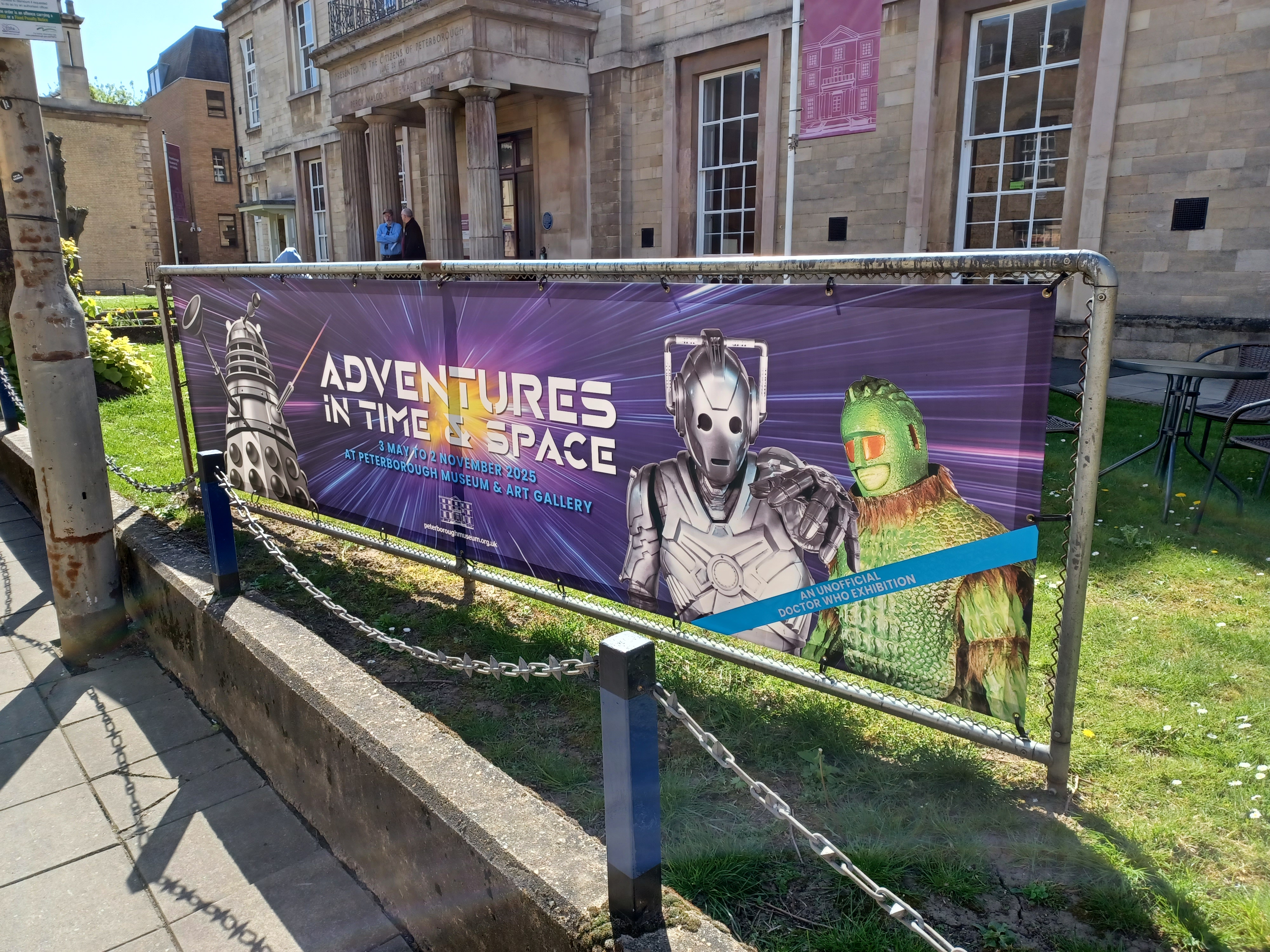
made clear! But I’d seen that Peterborough Museum and Art Gallery were having
the official opening of their new Doctor Who exhibition on Saturday,
with Peter Purves doing the honours. I thought it would make for a nice package
for our shared Norfolk-Suffolk-Cambridgeshire daytime show for the day after,
which handily is presented by my friend Thordis, who was very happy to take a
piece. I knew I could do a good job of it; the museum were happy for me to come
along; I established that nobody from Radio Cambridgeshire itself was going; so
on Saturday morning off I went on the train to Peterborough.
The reason I mention any of this at all is because for
the first, and probably last, time in my career I sort of accidentally found
myself being a ‘multi-platform’ reporter; that is, covering the same story for radio,
online, and indeed – uniquely for me – for television. Something which most reporters
do all the time these days, but as I’m not a reporter was a new experience for
me.
I had thought that there might be a decent online article
in it, so had suggested that I could perhaps put one together for them, but in
the end was asked to do two – one on the exhibition itself, and another focused
on the interview with Peter Purves which I was hoping to get. This I was also
fairly confident about – I am not a regular News Online writer but I have often
contributed features for them before, usually tied-in with one of my
documentaries or radio packages. I’d never really done an ‘on the day’ story
for them, but I was pretty confident I could do a decent job. I know the style,
and although I am not a natural writer of such pieces, I can do a good enough
impression of one to make life relatively easy for those actually putting it
online.
But I also found myself being asked to help out the
weekend TV team by filing some pictures for the Saturday Look East bulletin,
so they could cover the exhibition opening with what they call an ‘OOV’ – an item the
presenter reads ‘out of vision’ over a few shots of whatever the story happens
to be about. Now, if I am not really journalist, I am certainly not a video
journalist, which is a very specific skill. I was doubtful of being able
to file anything broadcastable, especially as my phone can’t shoot video in anything
close to broadcast quality. It’s also an Android, so only shoots in
30 frames per second anyway, which isn’t really any use to anybody.
However, for a few seconds’ worth they could just
about get away with it. I did my best to try and take some shots which moved, so were better than still photos, but didn’t pan
around wildly or wobble all over the place. Just to show what a 21st
century kind of guy I am I filed the shots back to Norwich while I was still in
Peterborough, so they had plenty of time to have a look and see if they could
salvage anything useable. And, rather to my surprise I must admit, they were actually
able to use a few shots, marking my debut – and doubtless, swansong
– as a television newsgatherer:
In fact, I ended up being so pleased with my efforts that
the next day I put my own little video together from the various bits I’d shot,
and stuck it up on YouTube:
Anyway, then it was back to Norwich on the train to be
congratulated for my new-found television skills, and a few hours writing the
two online features, putting together the radio package, and sorting some news
bulletin clips for my colleagues at Cambridgeshire (where the event took place)
and Suffolk (where Peter Purves lives). I also eventually ended up cutting the
Peter Purves interview as a straight ‘head-to-head’, as we call it, for another
show, and a version of the radio package for BBC Sounds.
Any actual BBC journalists reading this will be
rather bewildered that I am bothering recording all this at all, given that
they do this sort of thing day-in, day-out, each and every day. TV, radio,
online – it’s just what you do as a BBC reporter these days. You cover it all. I
am not expecting to be applauded just because I happened to be in a position to
have a dabble at it myself. But it was a useful reminder of the work that goes into
these things. And this was a self-chosen story, on a very soft subject about
which I know a very great deal and feel very comfortable discussing, taking
place at a fun event on a nice day with plenty of friendly and receptive people
willing to talk to me and no really restrictive time limit for filing. I can
only imagine how difficult it must be when you’re sent to cover a story in the
middle of nowhere in the pouring rain, with very little knowledge about what’s
taken place other than some people’s lives have just been ruined, nobody wants
to speak to you and you’re up against a very tight deadline, with a producer or
an editor anxious to know where the material is. It’s certainly not something I would want to do for a
living. But I do still enjoy doing it on the odd occasion when I have the time
and the opportunity to pick and choose something I would like to cover. Not
something which happens very often – even on Saturday, although I was working,
I was working on my own time, if that makes sense, as I wasn’t actually on-rota
or being paid for doing it.
But it was fun to do, I’m glad I did it and managed to
cover it for everybody, and it was nice to dip a toe into that ‘multi-platform’
reporting world.
Doctor Who has returned for its latest series this weekend. So it seems an appropriate moment to look back 20 years to when it really came back in the biggest way of all, with its first new series for 16 years and the start of what perhaps still stands as one of the greatest comebacks in the history of British television. If not the greatest.
That spring of 2005 was one of the most exciting times of my life. I know some might find it odd to find such vicarious fulfilment through the return and success of a television programme with which I had no direct connection, other than my passion for it. Most people who are in any way interested in reading this blog probably do understand it, but if not, you have to think about it a bit like being a fan of a football team. You have no involvement in the team or the game, no say over what happens, but when they win a major trophy it's bliss. It feels like everything. Everything you ever wanted.
That was what the return of Doctor Who felt like for me in the spring of 2005, and for many others, too.
I have very fond memories of that whole 18-month period from the announcement of the show's recommissioning in September 2003 to the point at which it finally arrived on screen in March 2005. It did feel like an eternity at the time, when I was so excited to see it, but there was so much to enjoy - the excitement of the announcement itself, the beginning of shooting, and before that point of course the casting news.
It's the casting of Christopher Eccleston as the Ninth Doctor which I have written about in the new Doctor Who Magazine special released earlier this month, celebrating the 20th anniversary of Eccleston's Doctor. I was asked if I would like to contribute to the special, I pitched a few ideas and I was very happy that this one was taken up, as I felt I was in a unique position to be able to contribute something on the subject.
Although Eccleston's name had been put forward by one or two fans in all the general discussion since the recommission announcement, there had been no widespread speculation about him becoming the next Doctor until the middle of March 2004. Then, just a few days before it happened, suddenly a leak suggested that he was the favourite and was about to be cast. I was astonished - he just wasn't someone I thought would be interested in the part, although I did suggest him as a possible candidate to play the Master in one online discussion thread.
But I was also incredibly excited, as having been a huge admirer of Our Friends in the North, in which he played Nicky - the character that, even at the age of 12 back in 1996, I found the most interesting of the four leads - I had followed his career with interest ever since. He'd of course starred in Russell T Davies's The Second Coming, which I had also liked a great deal, and while I remained unsure of how convincing the leak was, I was very excited about the idea that an actor I liked so much could be cast as the Doctor.
I remember very well sitting at the computer for most of the night on Friday the 19th into Saturday the 20th of March as first it seemed an announcement was imminent, and then it came - Eccleston was the Doctor. I don't think I went to bed until about 4am, following and joining in with all of the excited chatter on the Outpost Gallifrey forum.
And this was why I felt I was in a unique position to capture some of the excitement of that night. Outpost Gallifrey was unquestionably the main place for Doctor Who discussion online at the time, and when it closed down five years later I saved a few of the major discussion threads from 2003-04 period for posterity. One of which was the thread from that very night, as the news broke that Eccleston had been cast.
As far as I am aware, I am the only person to still have a full copy of that thread, so the only person in a position to write some of it up the the record. This was the idea which Doctor Who Magazine liked for the special, and it's the piece which has ended up being published. A little time capsule of how it felt to be a Doctor Who fan at that moment in the show's history.
In fact, the whole special issue is like that. It's a great reminder of so much of the fun and the thrill of the programme's return, not just the excitement of the very fact that it was back after so long, but that it returned so successfully, too. I am very pleased to have been asked to contribute to it, and I hope the piece brings back happy memories for those who were there in the build-up, and is an interesting historical document for younger fans who weren't.
Well, I actually don't know how many time they've checked it, nor how the items on it were selected, or how many people were involved in the process. But I do know that BBC Studios, the BBC's commercial subsidiary which among other things deals with licensing, merchandising and so forth, have published an official Doctor Who Christmas gift guide on their website for the show.
And I am on it!
Well, not me personally. You can't wrap me up and send me to the Doctor Who fan in your life as a Christmas present, which is probably good news for all concerned. But they have included among their recommendations the audiobook version of my book Pull to Open, which was released last month.
Okay, so the audiobook is an officially-licensed BBC Studios product, as indeed are all the other items on the list, so you may say that this is more of an advertising feature than anything else. And of course, you would be right. But there are plenty of other things they could have included, even just from the audiobook range. And for whatever reason, Pull to Open has been selected to be on it, which is rather pleasing.
Admittedly, I am not entirely certain how you give as a present something which isn't actually available as a physical product, but only via download. But it is, as they say, the thought that counts, and of course I would heartily endorse the idea of giving the gift of Pull to Open this Christmas! If nothing else, it presumably makes a good last-minute gift idea for a Doctor Who fan right up to and including on the day itself, as you don't actually have to either go out and buy it or get it delivered.
Incidentally, in the event that anybody is reading this after having received Pull to Open as a present - Christmas or birthday, the audiobook version or the full-length paperback - I'd love to hear from you. Especially if it was a welcome gift which you enjoyed, obviously! I like the idea of my work being given as a present, so do please leave a comment below and let me know!